You Have the Data. Now What?
A 1-Day Workshop for Qualitative Researchers Ready to Analyze with Confidence, Coherence, and Clarity — No More Second-Guessing, No More "Did I Do It Right?"
You're staring at transcripts wondering: Is this the right code? How do I organize all this? How does any of this become a theme? And how do I know I'm not just making it up?
January 3, 2026 | 11am-5pm ET
Claim Your Spot
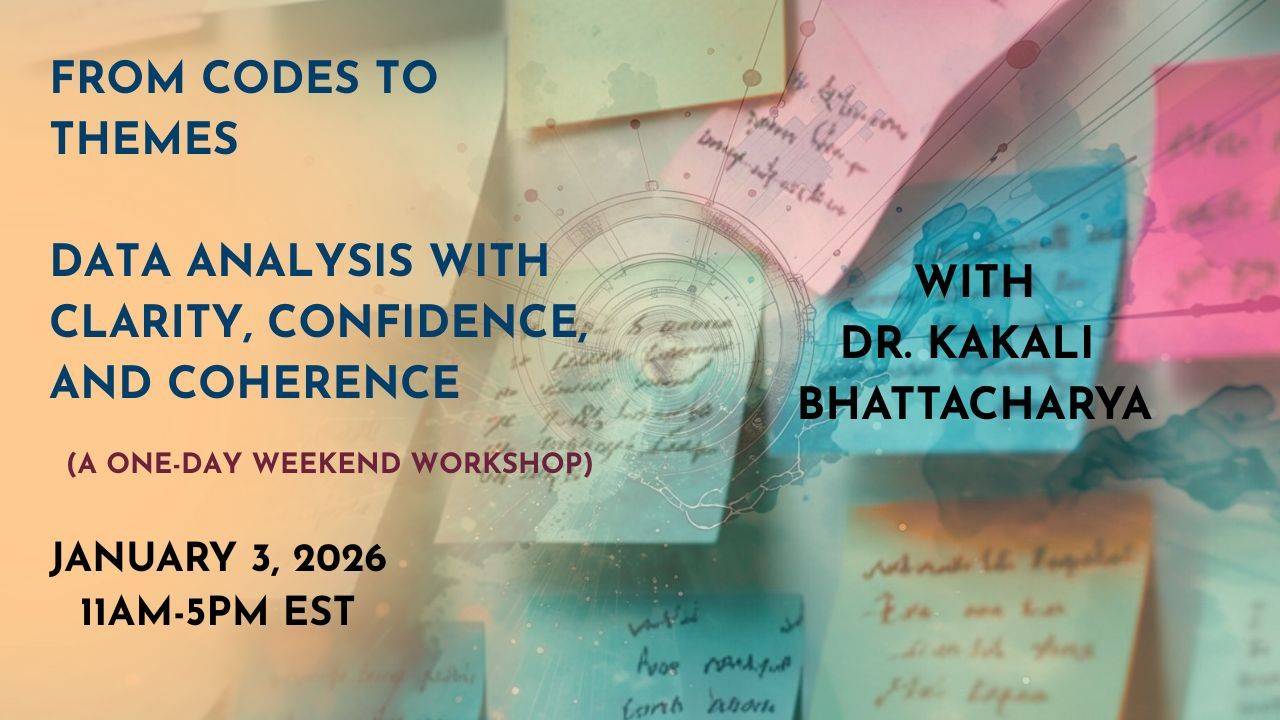
WORKSHOP DETAILS
When: January 3, 2026
- 11:00 AM - 5:00 PM Eastern Standard Time (Please adjust according to your timezone)
Where: Live on Zoom (link sent upon registration) Recordings and materials available for 60 days
Investment: $297
What's Included:
- 6 hours of live instruction
- Hands-on practice with your data (or a provided dataset)
- Personalized feedback
- Workshop materials and templates
- 60-day recording access
- BONUS: Follow-Up Q&A Session — February 12, 4-5pm ET via Zoom. Can't attend live? Submit questions via email and receive a recorded response. (Zoom link will be sent via email)
AFTER You Register: You'll receive Zoom links for the workshop and the follow-up Q&A session
WHY THIS WORKSHOP IS DIFFERENT
This Isn't Your Typical Technocratic Data Analysis Work
You're not going to be given step by step instruction like a recipe for a dish. Instead, you will learn to show up in your own intelligence and ways of knowing and being that will create the deepest anchoring, clarity, confidence and coherence in your work.
Sound Familiar?
"Is this the right code? Am I doing this with fidelity?"
You second-guess every decision. You're not sure if your codes are too broad, too narrow, or just wrong. You want to honor your participants' voices but you're terrified you're misrepresenting them.
"I tend to get lost in the data. My drafts are lengthy before I can succinctly name the finding."
You've got codes everywhere. Maybe hundreds of them. But you can't see how they connect. You can't see the story. You're drowning in pieces and can't find the whole.
"I don't know how to link from micro to macro. I'm not sure what to leave out."
You know your analysis should align with your framework, your participants, your research questions. But you can't see how the small codes connect to the big picture. And you don't know what's essential versus what's noise.
You've taken classes. You've read the books. But no one actually showed you HOW.
You need actionable, tangible steps. You need feedback. You need a thought partner who can look at your work and tell you what's working and what's not. But asking someone to do all that feels like a big ask.
That's where I come in.
Claim your spotWHAT YOU WILL ACTUALLY LEARN
- Know how to generate codes from raw data — and what makes a code actually useful
- Understand the difference between codes, categories, and themes — this matters because you can't just say "I coded and I have themes" and leave the interpretation process opaque like you're saying "trust me bro." Reviewers and committees need to see HOW you got there.
- Have a clear process for collapsing codes into categories and categories into themes
- See how micro-level codes connect to macro-level themes
- Build a theme tree that visually maps the relationships in your analysis
- Know what to keep and what to leave out
- Stop second-guessing and start trusting your analytical decisions
- Walk away with ACTUAL progress on your current project
You'll work with your own data — or if you're early in the process, I'll provide a dataset for you to practice with. Either way, you leave with real skill, not just theory.
No Cookie-Cutter Solutions: Every participant leaves with a process responsive to THEIR specific needs - whether you're in humanities, sciences, social sciences, or interdisciplinary fields.
Curriculum
Your 1-Day Transformation
JANUARY 3, 2026 is the day!
Morning Session (11:00am-12:30pm): Foundations
- The relationship between codes, categories, and themes — how they actually connect
- Can you code too much or too little? What if you have a coding fetish (over-coding everything) or coding frozenness (afraid to start, stuck in place)?
- What thought processes move you from micro to macro?
- How do you document your process so it's transparent, not "trust me bro"?
- What do you actually DO to create a theme with confidence?
- What makes a theme a theme — and how do you know when you have one?
12:30-1:00pm: Break
Afternoon Session 1 (1:00-1:15pm): Instruction for Thematic Analysis
- Concrete guidance before you dive into your data
Hands-On Practice (1:15-2:15pm): Work With Your Data
- Code, categorize, and thematize your data (or the provided dataset)
- Build your theme tree
- Individual support as you work
Big Group Discussion (2:15-3:00pm): Spotlight Mentoring & Feedback
- Watch others work through their stuck points
- Learn from different data types and decisions
- Direct feedback from Dr. Bhattacharya — real guidance, not vague praise
Pair Share & Reflections (3:00-3:30pm)
- Partner up and read each other's theme tree
- Assess clarity, coherence, and logical progression of your analysis
- Give and receive peer feedback
3:30-3:45pm: Break
Big Group Sharing (3:45-4:15pm): Questions & Answers
- Share your progress
- Get answers to what's still unclear
- Troubleshoot remaining stuck points
Wrap Up & Reflections (4:15-5:00pm)
- Integrate what you learned
- Make a plan for what happens after today
- Close the day grounded and clear
Who is This For?
This Workshop Is For You If...
- You want to understand and learn thematic data analysis in qualitative inquiry
- You have data and don't know how to start analyzing it
- You're early in your process and want to learn the skill before you collect data
- You started coding but you're lost or unsure if you're doing it right
- You have a pile of codes and no idea how they become themes
- You can't see how the small pieces connect to the big picture
- You want to represent your participants accurately and you're scared of getting it wrong
- You need someone to look at your work and give you real feedback
- You're tired of vague advice like "immerse yourself in the data"
This Workshop Is Not For You If...
- You want someone to do your analysis for you
- You're outsourcing your analysis to AI to save time
- You want a recipe-based guidance that is formulaic devoid of your own embodied positionality
- You're not willing to engage with data (yours or the practice dataset)
- You feel confident in your data analysis knowledge and you have no need for professional development in this area
- You are well passed data analysis and you have other professional development needs
- You don't appreciate the intimate, messy, intuitive, creative nature of qualitative work
- You find it difficult to be mentored because you are attached to how you do things.
Give 'Em Something to Talk About: Testimonials
Dr. Dina Maramba
Full Professor, Claremont Graduate University

Dr. Rhemma Payne
Assistant Professor, Western Kentucky University
Dr. Kiersten Greene
Associate Professor and Director, Childhood Education, Hunter College, CUNY
Meet Your Instructor
Dr. Kakali Bhattacharya

I'm Dr. Kakali Bhattacharya
I bring 20+ years of finding criticality, ethics, trauma-informed, cultural situatedness to qualitative research. I have been working on cultivating culturally congruent pathways of data analysis for over two decades that do not sacrifice your soul or agency. I am excellent at breaking complex ideas into actionable pieces without making it seem intimidating.
I am an award-winning professor with 100+ publications, who understands the unique challenges academics face when integrating new technologies.
Why Learn Thematic Analysis From Me
When I was a graduate student, I wanted a recipe. Just tell me the steps. Give me the formula. Let me follow it and get it right.
Twenty years of teaching data analysis every single semester taught me something different: recipes don't work. Step-by-step formulas collapse when your data doesn't behave the way the textbook said it would. What actually works is learning how to think through your data — anchoring in your own ways of being, knowing, thinking, and feeling so you can make analytical decisions from a grounded place, not from panic or mimicry.
I don't teach you a formula. I teach you how to sit with your data, notice what's unfolding in your thinking, what becomes more salient, what pulls you more, what analytical questions create a workable heuristic — and build an argument you can defend. Not because you followed someone else's steps, but because you understand why you made the choices you made.
No matter what philosophy of inquiry or framework you're using, I can partner with you and help you understand and justify your process so you can situate your work in scholarly ways that make you feel confident, clear, and coherent in your argument.
I've published 100+ works, trained thousands of researchers, and written the book that many graduate programs use to teach qualitative methods.
I don't do vague. But I also don't throw you into the deep end and watch you drown. The learning curve in qualitative analysis is steep. I stay responsive. I meet challenges with you. I support you through the hard parts — not by doing it for you, but by helping you find your own way through.
Frequently Asked Questions
You have questions? We have answers. Check out the questions below and if you're still sitting with more questions, do not suffer. Email Dr. Bhattacharya at [email protected]
What if I haven't started coding yet?
Can I share course info with a friend?
What if I can't attend live?
What if I don't have data yet?
What if I've already started coding but I'm stuck?
What if I'm using NVivo, Atlas.ti, Dedoose, or another software?
Will this work for my methodology?
What kind of data should I bring?
What's the follow-up Q&A session?
Enroll Now to Claim Your Spot. We start live session on January 3, 2026.
From Codes to Themes: Data Analysis with Clarity, Confidence, and Coherence
Your Investment
$297
This amount will be credited towards our S2S Mentoring Program if you choose to apply and get accepted. S2S Mentees receive all workshops for free.
Have you scrolled all the way to here?
We admire your need to know everything. No shade, just recognizing how we are so alike.
Ready to Stop Hiding Your Data Analysis Questions and Curiosity?
There are very few places where mentoring is focused on the shape of you and not the shape of force fitting yourself or a sliver of yourself into academic formats and expectations.
-
You can keep staring at your transcripts hoping themes emerge magically (hint: they never "emerge" ever)
-
You can keep second-guessing every code.and let the impostor monster take over and you become frozen
-
You can keep feeling lost in the data with no clear path through.
-
Or you can spend one day learning the actual process — with real data, real feedback, and a clear path from raw data to a thematic outline
January 3, 2026. One day. Real progress.
